
Holiday gatherings get busy fast. People arrive, food appears, children race off to see each other, several conversations happen at once, and someone inevitably starts looking for the tape or scissors nobody can find. For a grandparent with dementia, figuring out how to join all that activity isn’t always easy.
Grandchildren sometimes need help finding their place in the relationship, too. They may love spending time with Grandma but not understand why she asks the same question several times, loses track of their stories, or no longer plays a favorite game the way she used to. So how can you find common ground across generations during the holidays?
Instead of expecting children to figure out those changes on their own, adults can make the time they spend together much more comfortable for both of them. And that doesn’t require an elaborate intergenerational activity involving matching T-shirts and a craft table. Often, simpler works better.
Give them something to do while they’re together.
Conversation asks quite a bit of someone with dementia. Your parent has to hear what was said, understand it, come up with an answer, and keep track of where the conversation goes next. A fast-talking grandchild and a noisy room add another layer of difficulty.
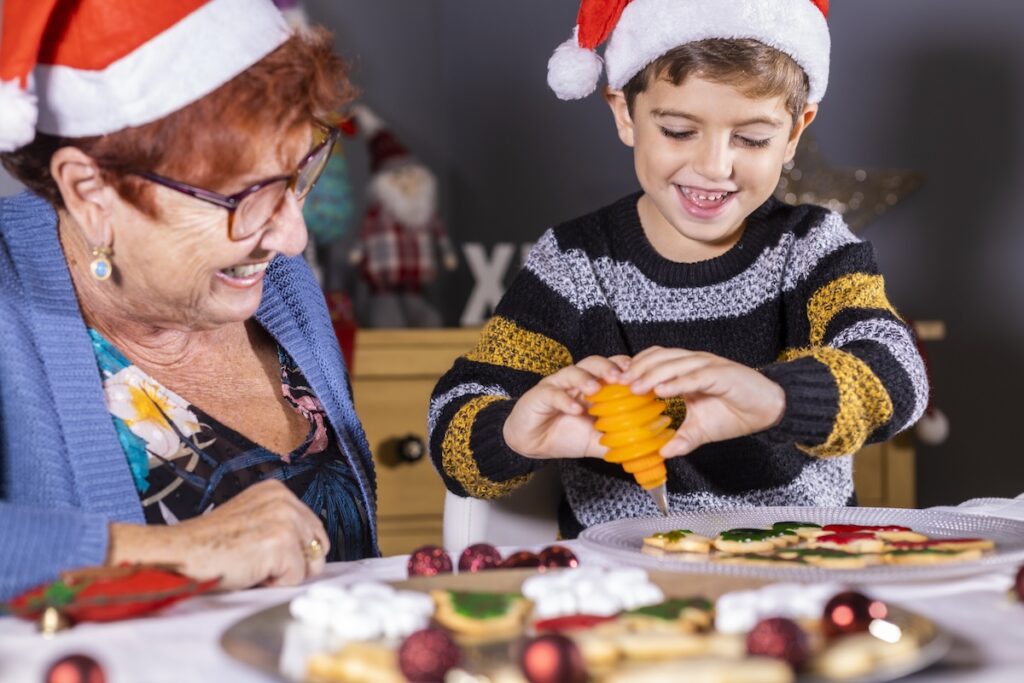
Try sitting them next to each other with something they can do. Grandma and her grandchild could shape cookie dough, address holiday cards, arrange decorations, or put napkins on the table. Because their attention isn’t fixed entirely on each other, pauses in the conversation don’t become awkward. They can talk when they want to and keep working when they don’t.
This approach works especially well with younger children, who usually prefer doing something to being told to “sit and visit” anyway.
Bring out things your parent already enjoys.
You don’t have to invent new activities just because your parent has dementia. Start with the things they’ve always liked and find an easy way for a grandchild to join them.
If Grandpa loves music, let a grandchild choose a few songs to play for him and then listen to some of his favorites. If Grandma has always enjoyed baking, she could shape cookies while a grandchild decorates them. A parent who loves looking at photographs could sit with a grandchild and flip through an album without anyone worrying about names, dates, or identifying every person in the pictures.
Pay attention to the grandchild’s interests as well. A child who loves drawing could make pictures alongside Grandma, while another would rather show Grandpa a new toy or sit with him and the family dog. There’s no reason every grandchild has to interact with your parent in the same way.
Explain dementia before the gathering.
Children notice changes, even when adults don’t talk about them. Without an explanation, a child could assume Grandma wasn’t listening when she forgot something they just told her or wonder why Grandpa called them by someone else’s name.
Tell them what’s happening in words they understand. For a younger child, that could be as simple as explaining that Grandma has an illness that makes it harder for her brain to remember things. An older child will probably have more questions and be ready for a fuller explanation.
It also helps to tell them what to do in situations they’re likely to encounter. If Grandma repeats a question, they can answer it again. If she loses track of a story, they can move on instead of trying harder to make her understand. Knowing what to expect takes some of the uncertainty out of the visit.
Leave the memory tests out of it.
Family gatherings naturally bring up old stories, photographs, and memories. Enjoy them, but be careful about turning them into questions your parent has to answer correctly.
A grandchild who asks, “Grandma, do you remember coming to my school concert?” is probably hoping to share a happy memory. If Grandma says no, the child may start supplying more details in an effort to make her remember. Before long, both of them know she has forgotten something important.
Show rather than quiz. “Here’s a picture from my school concert” gives Grandma something to look at and talk about without requiring her to remember the event. Instead of asking Grandpa whether he remembers an old ornament, hand it to him and talk about what you notice.
If a memory comes back, enjoy the story. If it doesn’t, move on without making the missing memory the center of attention.
Let the visit end while everyone is still enjoying it.
Grandparents and grandchildren don’t have to spend the whole afternoon together for the visit to count. A busy house gets tiring for someone with dementia, and children eventually want to return to whatever the other kids are doing.
Pay attention instead of watching the clock. If Grandpa is getting tired or a child is becoming restless, give them both permission to stop. Ten pleasant minutes decorating cookies together is better than stretching the activity until one person is exhausted and the other is desperate to escape.
The holidays give grandchildren and grandparents a chance to know each other as they are now. Dementia changes some of the ways they spend time together, but there are still plenty of ways to laugh, share an activity, sit quietly, or simply enjoy being in the same room.
Let Us Help Make the Holidays Brighter
Caring for a parent with dementia adds another layer of responsibility to an already full holiday season. We’re here to help with personal care, meal preparation, transportation, companionship, and other needs at home, giving you more freedom to spend time with the people who came to see you.
Call Compassionate Care Home Health Services at 877.308.1212 and tell us where some extra help would make the holidays easier for you and your parent in West Branch, Traverse City, Saginaw, or anywhere else across Northern and Central Michigan. We’ll take care of some of the caregiving so you don’t have to spend the whole celebration doing it.